
Search
-
or select -
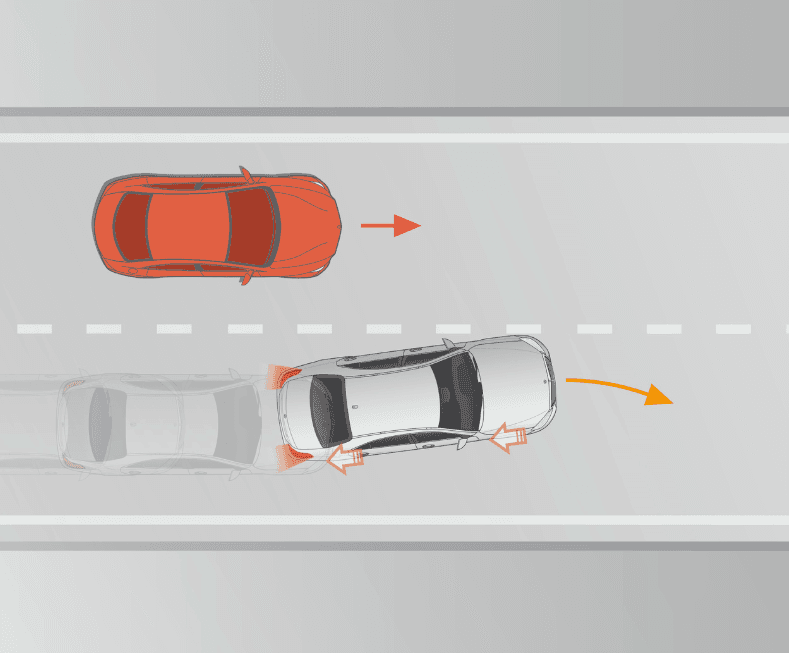
The Active Blind Spot Assist system is able to support the driver in carrying out a lane-change with maximum safety – in the city, on multi-lane highways and motorways. In city traffic, cyclists can also be detected. The system takes the strain off the driver by being able to warn of vehicles detected in the blind spot and if necessary is able to avoid collisions. In doing so, Active Blind Spot Assist differentiates between a warning zone and a collision zone.
The system’s brake interventions are perceived by the driver as deceleration and/or slight steering movements of the vehicle. If the driver or a prioritized driving safety system intervenes, for example ESP® or Active Brake Assist, the course-correcting brake intervention is suppressed and/or terminated.
The warning zone extends from the B-pillar towards the rear, up to 5m behind the bumper, and to the sides it stretches to a line 3m from the vehicle. The collision zone is adjusted at the sides depending on the speed. At 8 km/h, the distance at the sides is 1.5m, and at increasing vehicle speeds it extends to 2.5m up to 60 km/h. Towards the rear, the collision zone extends to 1.5metres behind the vehicle. 2 specific radar sensors fitted to the sides of the rear bumper monitor the area of the so-called blind spot.
When driving forward, the system creates a warning above a minimum speed of 8 km/h if it detects a vehicle in the corresponding zone. Course-correcting brake intervention can be initiated in the speed range between 30 and 200 km/h. The display and warning of vehicles in the blind spot are also available to the driver at speeds over 200 km/h.
Active Blind Spot Assist can be activated via the multimedia system. In addition to the red triangles in the exterior side mirrors, system warnings are also shown in the multifunction display. In addition, a graphic in the multifunction display informs the driver that Active Blind Spot Assist has detected a risk of a side collision with a vehicle in the blind spot, and is taking corrective action.