You Are Here: Home > INTELLIGENT DRIVE > Active Brake Assist with Cross-Traffic Function

Active Brake Assist with Cross-Traffic Function

In a nutshell

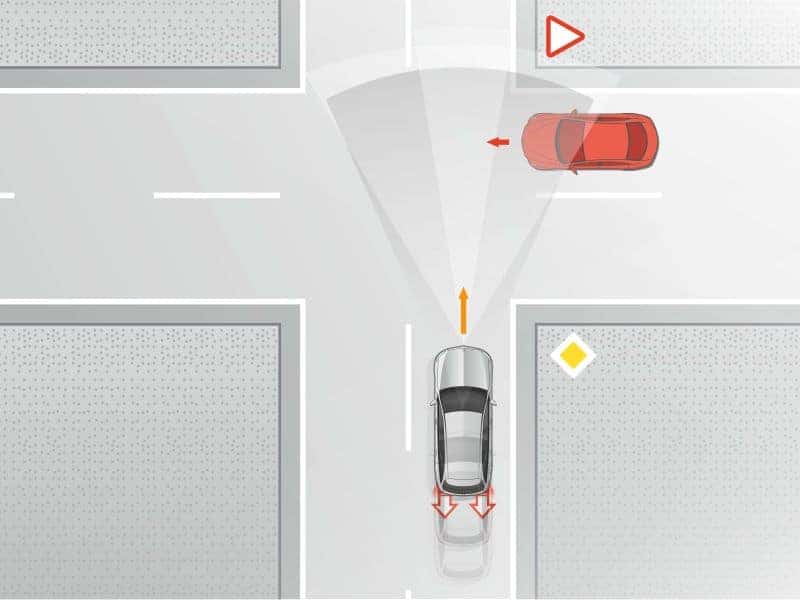
If an accident risk is detected, the system can assist with emergency braking and, in an emergency, apply the brakes automatically. It can detect slower-moving, stopping and stationary vehicles as well as cross-traffic at junctions, vehicles at the end of a traffic jam and pedestrians in the danger zone with the aid of radar sensors and the stereo multipurpose camera. If danger is detected, the system gives the driver a visual and audible warning. If the driver reacts and brakes, it can boost the braking effect on demand if required, right up to full brake application. If the driver fails to react, the system can brake the vehicle automatically.
Overview

  1. Stereo multipurpose camera and radar-based driving assistance system that can help avoid accidents with vehicles ahead or crossing vehicles, with crossing pedestrians or pedestrians in the path of the vehicle, and at the end of a traffic jam, and/or mitigate the consequences of accidents
  2. Combination of proximity warning, collision warning, on-demand braking assistance and automatic braking function
  3. Visual warning in the form of warning lamp in the multifunction display if the safe distance is insufficient
  4. Additional audible warning if the distance continues to close rapidly and a collision is imminent
  5. If the driver initiates emergency braking – if necessary – increase in braking pressure by the on-demand braking assistance
  6. Initiation of automatic braking if the driver fails to react prior to an impending collision
  7. Visual and audible warning plus almost simultaneous automatic emergency braking if an impending collision with a crossing pedestrian or pedestrian in the path of the vehicle is detected
  8. The emergency braking function can reduce the speed automatically at the end of a traffic jam when there are no options for evasive maneuvers and thus prevent an accident or reduce its impact

Components

  1. Stereo multipurpose camera behind the windscreen in the area of the rearview mirror
  2. Radar sensor behind the front grille
  3. Radar sensors in the front and rear bumpers


Operation and technology

Stereo multipurpose camera and radar sensors – to detect hazards

The proximity and collision warning function of the Active Brake Assist with Cross-Traffic Function receives its data from a radar sensor built into the front grille and a stereo multipurpose camera located behind the windscreen. The stereo multipurpose camera and the radar sensor permanently determine the distance to vehicles ahead and crossing vehicles, stationary objects, and pedestrians moving in the vicinity of the vehicle.

On-demand braking assistance – to assist the driver with braking

If there is an audible collision warning, the system activates on-demand braking assistance. This function calculates the braking pressure that would be necessary to prevent a rear-end collision. If the driver applies the brakes heavily, on-demand braking assistance increases the braking pressure automatically until it reaches the required level if necessary. This also gives following traffic the most possible reaction time. In the event of emergency braking, ABS prevents the wheels from locking. When the brake pedal is released, or there is no longer a danger of collision, the intervention by on-demand braking assistance ceases.

Automatic braking – to reduce the accident risk if the driver fails to react

If the driver does not brake or maneuvers despite visual and audible warnings, the system automatically initiates automatic braking, substantially reducing the vehicle’s speed. At low relative speeds, this can be sufficient to prevent a rear-end collision. If the driver operates the brake pedal during autonomous brake actuation, on-demand braking assistance intervenes to decelerate the vehicle, even as far as full brake application if the situation requires it.

Switching the system on and off

The proximity warning and automatic braking can be switched on and off via the left control panel on the multifunction steering wheel by selecting the corresponding menu in the multifunction display. On-demand braking assistance is permanently active in the background and cannot be deactivated.

The sensitivity of the system is adjustable in 3 levels

  1. Early: the intervention points are set to very sensitive. In this setting, the system ensures the highest possible level of safety. The intervention points can be perceived as disruptive in some situations, however.
  2. Medium: the intervention points are programmed with the best possible configuration for maximum safety without disruptive interventions. This level is set automatically if the system was switched off during the last trip.
  3. Late: the intervention points are programmed much later. With this setting, the customer no longer obtains maximum benefit from the system. This setting should only be used when adopting a very sporty driving style.
Mercedes-Benz of Charleston 32.7844494, -80.0041629.