
Search
-
or select -
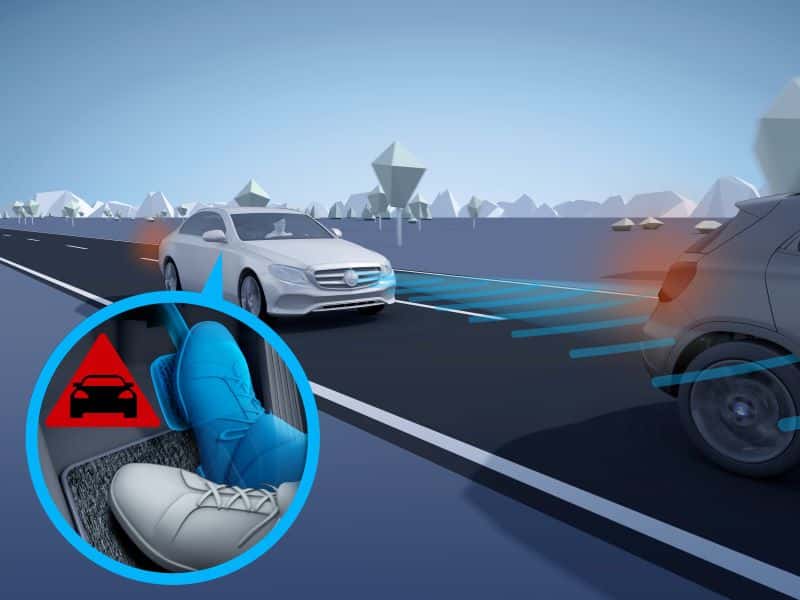
Insufficient distance from the vehicle in front and inattentiveness are the main causes of serious accidents. Active Brake Assist can help prevent accidents with vehicles in front and with crossing pedestrians and/or mitigate the consequences of accidents. To this end, the radar-based system activates a visual distance warning depending on the situation and, if necessary, an additional audible collision warning. When the driver steps on the brakes, he or she is helped, if necessary, by situation-dependent braking assistance in the form of additional braking force. Automatic braking is activated if, with a rear-end collision imminent, the driver does not react to the warnings from the system. If an accident with a crossing pedestrian is imminent, automatic emergency braking takes place almost simultaneously with the visual and audible warnings.
If the safe distance to a vehicle in front drops below a few seconds in the distance warning speed range, a warning symbol lights up on the multifunction display. If the system detects that the distance is rapidly closing owing to high speed or hard acceleration, there is an additional audible warning in the form of an intermittent tone.
If the driver reacts with emergency braking, he or she is helped by the situation-dependent braking assistance, which, if necessary, builds up additional brake pressure in order, if possible, to prevent a collision.
If the driver does not respond, the system automatically initiates automatic braking. substantially reducing the vehicle’s speed. At low relative speeds, this intervention can be sufficient to prevent a rear-end collision.
The emergency braking function is designed to help prevent collisions with pedestrians who cross the road without paying attention or who the driver fails to see, or mitigate the consequences of accidents. If the radar sensor system detects a hazardous situation, emergency braking is initiated at almost the same time as the visual and audible warning.
Active Brake Assist proximity and collision warning is based on data received from a radar sensor that permanently checks the distance to vehicles ahead, stationary objects and pedestrians moving near the vehicle.
If there is an audible collision warning, the system activates the situation-dependent braking assistance. This function calculates the braking pressure that would be necessary to prevent a rear-end collision. If the driver applies the brakes heavily, situation-dependent braking assistance further increases the braking pressure automatically until it reaches the required level if necessary. This also gives following traffic the most possible reaction time. In the event of emergency braking, ABS prevents the wheels from locking. When the brake pedal is released or if there is no longer a danger of collision, the intervention by the situation-dependent braking assistance ceases.
If the driver does not brake or maneuver despite visual and audible warnings, the system automatically initiates automatic braking, substantially reducing the vehicle’s speed. At low relative speeds, this can be sufficient to prevent a rear-end collision. If the driver operates the brake pedal during automatic brake application, situation-dependent braking assistance intervenes to decelerate the vehicle, even as far as maximum full-stop braking if the situation requires it.
The radar sensors can detect pedestrians moving near the vehicle and constantly measure whether a detected pedestrian is on a collision course with the vehicle. The system can only detect pedestrians who are in the area scanned by the radar. The emergency braking function is optimised to detect crossing pedestrians who are moving at a right angle to the direction of travel.
The distance warning is switched ‘On’ and ‘Off’ via the left control panel on the multifunction steering wheel by selecting the corresponding menu in the multifunction display. Situation-dependent braking assistance is permanently active in the background and cannot be deactivated.